Labels

Welcome to the Eastern Moors blog site. In recent months this has been updated so that wardens, volunteers and supporters can now write blogs, submit photographs and comment on Eastern Moors topics. Please click on an appropriate tab above to get involved. If you are unsure how to post a picture, article or comment then please look at the Users Guide or email us.

Wednesday, 31 December 2014

A snowy day


As a warden on the Eastern Moors you are never quite sure what the day will bring, you may have a plan but often unexpected things crop up. Today I was greeted by a beautiful sunrise and a small group of deer grazing by the snowy track over the moor to the office.

Since the snow fall my days have been taken up checking the car parks and the boundary walls for damage as well as walking the main routes to check for fallen trees. You may remember last year that a large number of trees were uprooted due to the strong winds. This time round it is the weight of the snow which has brought down limbs and trees.
So this morning I set off around the woods below Curbar edge to check the paths with Buddy, my trust companion. It wasn’t long before we were dragging fallen birch branches out of the snow and off the paths. Many of the larger birch branches had snapped with the weight of snow, while some of the smaller trees had been bent over with snow covering their tops which were now frozen to the ground, creating little archways. So braches were cleared and trees were freed while Buddy scampered around and sniffed at deer tracks in the snow.
Eventually were came across something that would be a bit more of a challenge, more than a warden, a dog, and a bowsaw could tackle. One of the lovely large oaks had decided it’s time was up, and lay uprooted on the pipe track. It was one of my favourite trees on the estate, a gnarly oak with character that only hundreds of years can produce. Dealing with this will take the whole warden team kitted out with a winch and chainsaws, lets hope the guys come back feeling fit after the Christmas break. But the story for this oak isn’t over, once moved out of the way, this fantastic big tree will take decades to break down, during which time it will provide valuable habitat for a whole range of wildlife. Whilst it decays, the space it has created in the canopy will allow light to reach the woodland floor, and a new generation of trees will take advantage of this opportunity to takes its place.

Happy new year everyone, Kim.

Monday, 24 November 2014

Looking back to warmer days....


As we head into the cooler months we review the ecological monitoring information that we gathered during the spring and summer of 2014. Monitoring is an important part of the work we do as it allows us to look at the potential affect that our management may have on habitats and wildlife. It also means we can build up a clearer picture of what species use the estate and in what ways so that we can target our management to be as beneficial as possible. Some projects have been well documented on the blog, the Curlew project being one of our focuses for this year, but many other things are counted, measured and recorded.
Female black darter at little Barbrook reservoir.
Some monitoring is carried out annually such as upland and woodland birds, snipe, woodcock, ring ouzel, whinchat, dragonflies, and red deer. While some is carried out every 3-4 years, vegetation recording for example, changes in habitat are slower and working in this way means we have more time to focus on different habitats by studying them on a 3-4 year rotation. During 2012/13 we recorded the upland vegetation; looking at the plant species and the structure of vegetation over the moorland as we battled through Molinia tussocks and traversed ditches.


Flowering hares tail cotton grass
In 2014 we started studying  woodland structure; recording features such as tree species and size, canopy cover, presence of shrubs and deadwood, as well as the ground flora. This time the challenge being head high bracken and midges.
 
 
Other specific species may be looked at if they become of increasing importance, Willow tit for example, were added to our monitoring early this spring as the RSPB were keen to learn where they are breeding due to concern about their decline.
We even have data that is recorded every 10mins 24 hours a day, luckily we have some clever gadgets which do this automatically for us! This kit is used to study the hydrology on the mire and uses pressure to record data on flow rates and water levels. We simply have to find the kit on the mire every few months and download the data.

 
Some of our data feeds into national databases; our bird data is entered into a national RSPB database and so informs the national picture of what is happening to our birds. Other data is used in local landscape partnerships, such as our hay meadow recording, where we pass our data onto the NIA (Nature Improvement Area) a grant which funds different projects in the area, including our hay meadow restoration.
Bee on yellow rattle in Curbar meadow.
Needless to say we could not possibly run such a comprehensive programme of monitoring without our volunteers who put in hours of hard work. Many came to us with fantastic skills such as bird identification, which we have put to good use, while others, new to monitoring, have been trained to enable them to use their new knowledge to contribute to our understanding of the estate. We are also increasing the work we do with groups that have been carrying out their own monitoring in the area before the partnership existed, such as Derbyshire amphibian and reptile group.

 
It is still too early to draw any conclusions about long term trends between our management and the impact it has on the habitats and wildlife of the estate, but we continue to use all the new information to inform our decisions on what we want to achieve and how we are going to get there.


Thursday, 20 November 2014

Eastern Moors logos

Just a few notes on the evolution of the EM logos.


I’m  a little more hesitant when going to Barbrook Cottage these days.  I always seem to come back with more than I went with, and I don’t just mean cow dung on my car tyres and boots!
Celia and I were up there last summer and someone, lets just call her KC, gave Celia a folder of children’s drawings with a request to check these over and see if there was anything which would sow the seed of a logo for Eastern Moors.  As a retired art teacher Celia would have knowledge of such things!
Although the art was good in itself, we were unable to use these as a basis for a logo.  Thus it was that ‘yours truly’ was sent out, with camera, to look for inspiration. Our brief was to reflect the moors, its history, its wildlife and its use by enthusiasts..
Here are a few of the first thoughts -


To fit all this into one logo would make it more complicated than the  Royal Coat of Arms and it was decided that a maximum of 4 individual logos would be the answer


So it was that the design process began.  Surprisingly the shapes for the ‘adder’ and ‘rock art’ sorted themselves and even the ‘red deer’ caused not too much heartache!  It was decided that a group of deer would be more family friendly than a dominant stag with massive antlers.


But the human activity! Where to start?  Walking, cycling, running, rock climbing, horse riding, photography, orienteering, bird watching, deer stalking….. The list goes on.
From a practical point of view we only had one colour to play with and this would be a silhouette overlaid on the colour of the shirt.  3D work was therefore out of the question as it is difficult without 3 colours!  So why the rock climber?


To start with this image enabled us to incorporate an Edge which is one of the main features of these moors. It also gives the sense of space and adventure. I am sure the powers that be would consider other sports or pastimes in the future but the climber for now ticks as many boxes as possible.
By placing 2 of the motifs against the setting sun we added to the sense of drama for these Moors and lightened up the whole image.

The original concept was for 4 individual designs and then allowing the choice of 4 tee-shirt colours - green, purple, grey and pink! 
By now our amateur work had been handed over to the professionals and it was becoming clear that there were far too many options.  With a degree of relief in some quarters, the pink was dropped and it was an inspired act to put all 4 designs together.
15 months later we now have the final product.  We hope you agree that the effort has all been worthwhile and that you will wear the shirt with pride when out and about!


 Roger November 2014


Friday, 31 October 2014

Totley scrub clearance

This week the wardens have been removing scrub from the mire habitat on Totley Moss.


Silver birch are wonderful trees and very characteristic of the Eastern Moors - we have lots of them! However we have been removing a small number of self seeded silver birch scrub from the south-west corner of Totley Moss, which is mire habitat. This is to allow species more typical of mire such as sphagnum mosses, cotton grass, cranberry and cross-leaved heath to increase and is part of other works such as ditch blocking to promote re-wetting of the area - i.e. getting it nice and boggy! The trees currently obstruct this by drying out the ground, and when they are removed the wetter conditions should stop them returning, but this will need to be monitored with potential follow up work to remove any young scrub that returns. There are also several stands of willow, but these will be left as they support a lot more birds and invertebrates and are less likely than birch to spread across the mire.
Shane surrounded by birch:


As you can see the terrain was pretty rough and boggy, so it was hard work traipsing across with chainsaws and all our kit. Some of the trees were densely packed but a lot were very widely spread which meant a long trek between each tree. To help us get around and thereby reduce the time spent on the job we had the help of this machine and Buddy, its expert driver:


It's called an Argocat and is specially designed for traversing wet, boggy ground - it has very low ground pressure so doesn't get stuck or damage the terrain. Apparently you can drive it into a lake and it will float but none have us have dared to do that yet!

Kim at work:


Before:


After, you can see the patches of willow that remain:


We managed to get it all done in two days which was faster than we thought. Hopefully now the mire can start to develop into a soggy paradise.


Friday, 17 October 2014

More red deer news

At rutting time the deer spread themselves more thinly over these moors as stags try to keep their harem of hinds away from the dominant bruisers who want them all in their own collection!
Currently therefore you have a chance to see deer in unusual places.
Only yesterday I came across a young mature stag with 6 hinds at 2 slabs bridge. They were little more than 250 metres from both Sheffield Road and Clodhall Lane but seemed quite at ease. There was another stag in the distance on the slopes above Swine Sty and he also had a harem of 6 hinds.
Although it is not rare to see deer round Swine Sty, it certainly is uncommon at 2 Slabs Bridge.
It is surprising therefore that we have not yet really seen the deer spread out onto the other moors. Totley has had a small population for some time and the occasional group turn up near Sheffield Road at the northern end of Ramsley Moor but other than than virtually nothing.

Another group that keep well out of the way at this time are the none breeders.  Hinds with calves from last year or even the year before rarely mate again until the third year and the young stags and hinds usually don't breed until their fifth year. 
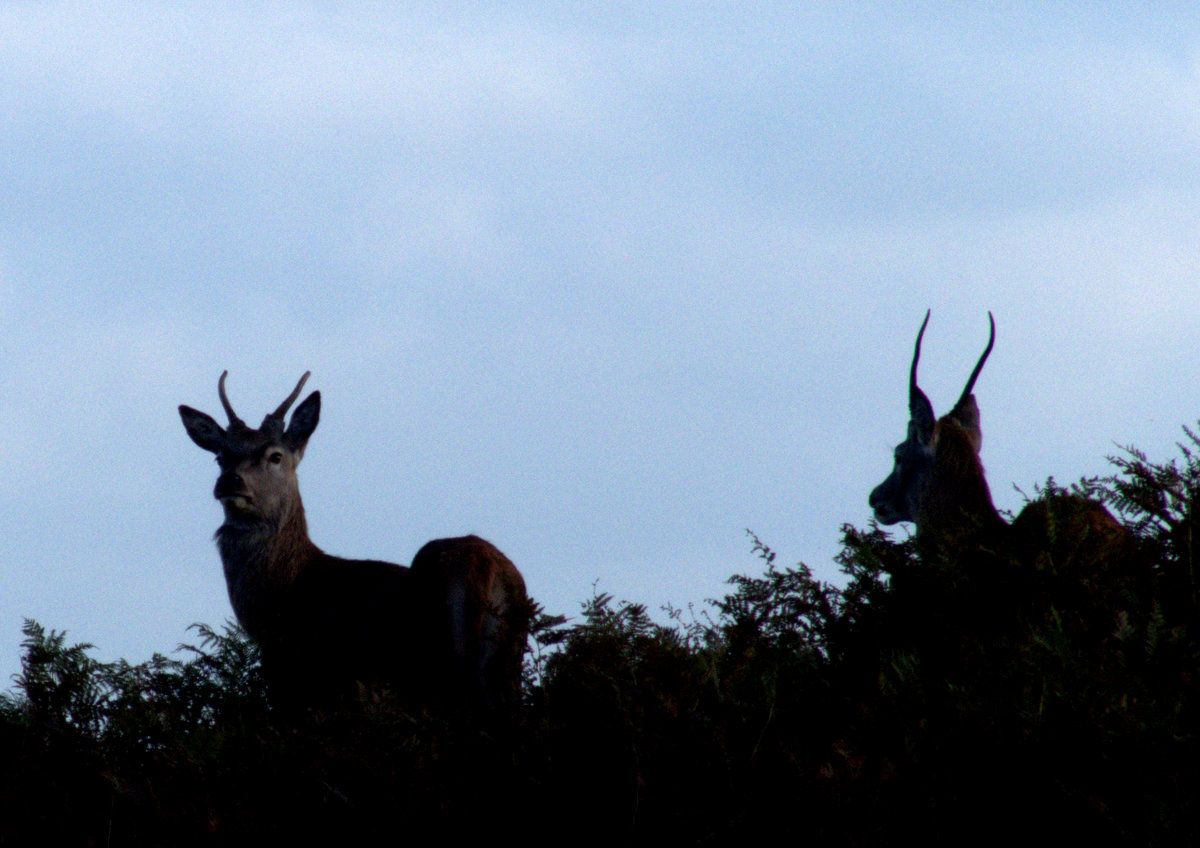
On the road up to Barbrook Cottage I came across a group of four yesterday.  A young mother with her calf and two 'spikers' A spiker is a young stag with a pair of unbranched antlers.  They were reluctant to leave the 'safety' of this area and were still about when I returned 30 minutes later.